
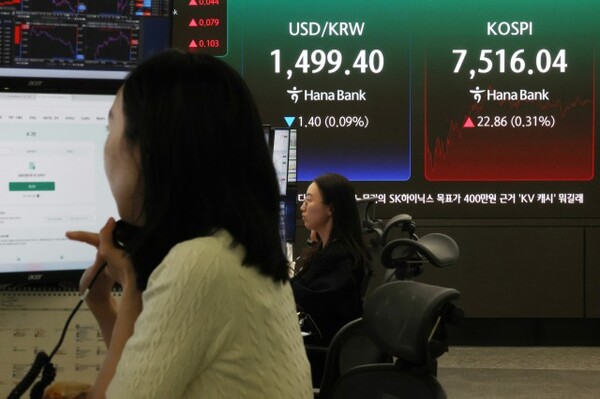
On the afternoon of May 18, the won-dollar exchange rate and KOSPI figures were displayed on an electronic board at Kookmin Bank in Jung-gu, Seoul.
The KOSPI showed extreme volatility, plummeting more than 4% in early trading and triggering a sell sidecar, but the index recovered the 7500 level driven by a rebound in large-cap stocks centered on Samsung Electronics.
According to the Korea Exchange, the KOSPI closed at 7516.04 on this day, up 22.86 points (0.31%) from the previous trading day.
The KOSPI opened at 7443.29, down 49.89 points (0.67%) from the previous trading day, and quickly expanded its decline, falling to the 7100 level in early trading. As the index dropped to the 5% level, a sell sidecar was also triggered at 9:19 a.m. and later lifted. Afterward, the KOSPI turned upward, supported by buying from retail and institutional investors, and recovered the 7500 level.
The foreign selling trend that has continued since May 7 persisted on this day as well. Foreign investors net sold 3.6515 trillion won (approximately $2.43 billion) worth of shares in the KOSPI market. On the other hand, retail investors and institutions net bought 2.2086 trillion won ($1.47 billion) and 1.3912 trillion won ($927.47 million) worth, respectively, stepping in to defend the index.
The semiconductor ‘two tops’, Samsung Electronics and SK Hynix, which showed weakness in early trading, both closed higher. Samsung Electronics rose 3.88%, and SK Hynix gained 1.15%.
In particular, Samsung Electronics’ stock price surged more than 6% during intraday trading as the court partially cited the ‘injunction against illegal industrial action’ filed by the company against the labor union. Three days ahead of the general strike scheduled by the Samsung Electronics labor union, labor and management entered their second post-mediation meeting under the mediation of the National Labor Relations Commission.
In addition, SK Square, Hyundai Motor, and LG Energy Solution closed down 0.46%, 5.29%, and 2.16%, respectively. On the other hand, Samsung Electro-Mechanics, Doosan Enerbility, and Samsung C&T rose 2.08%, 1.17%, and 0.76%, respectively.
Han Ji-young, a researcher at Kiwoom Securities, diagnosed, “Major global stock markets were enjoying a record-high rally created by AI stocks such as semiconductors, while maintaining a low sensitivity to macroeconomic and geopolitical uncertainties.”
She continued, “However, the atmosphere changed rapidly as the US 10-year Treasury yield broke through 4.5%, which was considered the market’s psychological resistance line, last week,” explaining, “Concerns over prolonged energy inflation have also grown, with international oil prices once again exceeding $100 per barrel following remarks by US President Donald Trump suggesting the possibility of resuming war.”
She added, “In the aftermath, tightening uncertainties expanded in the market, with the outlook for the Federal Reserve (Fed), which had been expected to freeze interest rates until next year, taking a sharp turn toward the possibility of a rate hike in January next year, and this appears to have further cooled down investor sentiment.”
The KOSDAQ index closed at 1111.09, down 18.73 points (1.66%) from the previous trading day.
In terms of supply and demand, a different trend from the KOSPI emerged. Foreign investors net bought 230.3 billion won ($153.53 million) worth of shares, while retail and institutional investors net sold 7.4 billion won ($4.93 million) and 255 billion won ($170 million) worth, respectively.
Top market capitalization stocks generally showed weakness. Alteogen fell 3.12%, EcoproBM fell 0.05%, Ecopro fell 1.86%, Rainbow Robotics fell 7.90%, Kolon TissueGene fell 2.87%, and Samchundang Pharm fell 3.74%. On the other hand, Jusung Engineering surged by the daily price limit of 29.96% on the news of atomic layer growth (ALG) semiconductor manufacturing equipment shipments.
Meanwhile, the won-dollar exchange rate has settled in the 1500 won range, continuing its peak trend. As foreign investors continue their large-scale selling of domestic stocks, demand for dollar exchange is expanding, and upward pressure on the exchange rate appears to be strengthening.
In the Seoul Foreign Exchange Market on May 18, the won-dollar exchange rate closed at 1500.3 won as of 3:30 p.m., down 0.5 won from the previous trading day. The exchange rate opened at 1501.2 won on this day and repeatedly fluctuated around the 1500 won mark during intraday trading before closing in the 1500 won range.
The strong dollar trend is continuing. The dollar index, which indicates the value of the dollar against six major currencies, stood at 99.23, down slightly from the previous trading day (99.28), but still maintains a peak level.
The dollar is under upward pressure due to the re-emergence of geopolitical risks from the Middle East. US President Donald Trump issuing a hardline message toward Iran is cited as the background for the strengthened safe-haven appetite. In addition, individual risks in major countries, such as political uncertainty in the UK, are supporting the strong dollar.
In terms of domestic supply and demand, foreign stock selling is considered a key variable in the exchange rate rise. Entering this month, foreign investors are analyzed to have engaged in profit-taking and rebalancing by net selling the KOSPI on a large scale. Accordingly, it is evaluated that the trend of converting won assets into dollars is continuing, expanding the supply and demand imbalance in the foreign exchange market.
Moon Da-woon, a researcher at Korea Investment & Securities, said, “The biggest factor behind the recent exchange rate rise is foreign selling of domestic stocks,” and “Profit-taking and rebalancing following a surge in domestic stock returns appear to have increased selling pressure.”
In the bond market as well, concerns over foreign capital outflow are expanding as interest rates continue to rise. Rising interest rates increase the burden on asset valuation while simultaneously inducing portfolio adjustments by global investors, structuring into additional dollar demand.
Kim Yoo-mi, a researcher at Kiwoom Securities, explained, “With US Treasury yields rising due to inflation concerns caused by rising oil prices, the safe-haven appetite is strengthening, and the dollar is showing strength,” adding, “The British pound is showing weakness due to lingering political uncertainty.”
Min Kyung-won, a researcher at Woori Bank, analyzed, “The rise in global Treasury yields, which began with the reignition of inflation concerns, is leading to valuation burdens in the stock market,” and “As the speed of the KOSPI’s rise was fast, foreign capital outflow is accelerating, stimulating reverse remittance demand and offshore speculative long sentiment, increasing upward pressure on the exchange rate.”
There are also observations that the exchange rate could move within a range of 1460 to 1520 won in the future. The market expects a period of expanded volatility to continue depending on foreign supply and demand, as well as global interest rate and oil price trends.