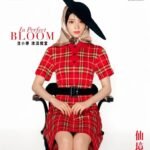
Girl’s Day Hyeri — SENSE Magazine, September 2026 Issue Covers

The room changes first
Before Hyeri speaks, the room has already made its decision.
There is the floral sofa, faded and theatrical beneath the low amber light. There is the polished black shoe, the pearl-like detail catching the eye before the movement does. There is the yellow skirt cutting through the frame like a flash of sunlight in a room built from shadows. And then there is Hyeri herself: composed, alert, almost impossibly still.
The image does not ask to be understood immediately. It asks to be felt.
This is Hyeri in the present tense—not frozen inside the nostalgia of a beloved group, not reduced to the shorthand of a television character, and not presented as a former idol revisiting a familiar chapter.
She appears instead as something more elusive and more powerful: an artist who has outgrown the categories that once made her easy to define.
In an era when K-pop’s global image is increasingly engineered for instant recognition, Hyeri offers a different kind of impact. Hers is not the spectacle of excess. It is the electricity of contrast: softness against severity, humour beside poise, intimacy within glamour.
Beyond the familiar frame
Hyeri’s cultural temperature is unusually warm. She remains recognisable to millions through Girl’s Day, whose music and personality helped shape a formative chapter of modern K-pop, but recognition is only the surface of her current relevance. What makes her compelling now is the way she inhabits transition.
She belongs to a generation of performers who helped move Korean pop culture from domestic phenomenon to global language.
Yet she also represents what happens after the breakthrough: the long, complex life of an artist who continues to evolve once the world has learned her name.Her trajectory has never been contained by one medium. Music established her as a performer with instinctive timing and emotional accessibility.

Acting expanded the frame, revealing an ability to move between comedy, vulnerability, romantic tension and grounded realism without losing the qualities that made audiences feel close to her.
That closeness is not accidental. Hyeri’s appeal has always rested on a rare balance between star quality and recognisable humanity. She can command a cover while still seeming to understand the viewer on the other side of the screen—the fan watching on a phone, replaying a scene, saving a styling detail, or returning to an old performance because it still carries a particular feeling.
That relationship has become even more significant as idol culture changes. The contemporary pop star is no longer experienced only through albums, broadcasts or live stages. Stardom now travels through clips, edits, comment sections, airport photographs, livestreams, fan translations and algorithmic afterlives.
Hyeri’s image survives that acceleration because it is not built on a single pose.

Fashion with a pulse
The first cover’s visual language is deliberately cinematic. Against the dark floral sofa, Hyeri becomes both character and author. The black top creates a clean vertical line through the composition, while the yellow skirt introduces warmth, movement and a note of playful defiance.
The styling is not simply decorative. It functions as emotional architecture.
The look suggests a woman who understands that femininity can be theatrical without being fragile. The pearls at the shoes add a vintage sweetness, but the black silhouette keeps the image from becoming sentimental. Everything is familiar, yet nothing is passive.
This is where Hyeri’s fashion identity becomes especially interesting.
She does not treat clothing as a costume that replaces personality. She uses it as a second voice—one capable of speaking before a lyric, a line or a gesture arrives.
The second cover changes the temperature completely.
Here, Hyeri stands against a pale wood backdrop in a sharply tailored black ensemble. The white shirt and narrow tie create a disciplined rhythm, while the long coat gives the silhouette an almost cinematic severity. The image could suggest rebellion, restraint or reinvention, depending on how long one looks at it.
Her expression is direct but unreadable. She is not performing approachability. She is allowing distance to become part of the story.
That tension is central to contemporary fashion imagery. Global K-pop styling often moves at the speed of the feed, demanding a look that can be identified in half a second. Hyeri’s cover presence works differently. It rewards the second glance, the pause before the swipe, the visual memory that remains after the image has disappeared.
The art of staying in motion
Hyeri’s evolution is not a straight line from idol to actor, or from performer to fashion figure. It is more like a series of rooms, each opening into the next.
Girl’s Day gave her a foundation in group chemistry and live performance. That world demanded precision, adaptability and the ability to make a few seconds of screen time feel memorable. It also taught her the value of personality—how a glance, laugh or spontaneous reaction can become as culturally important as a perfectly executed pose.
Acting sharpened those instincts.
On screen, Hyeri’s strength has often emerged through movement: the sudden shift in expression, the physicality of a reaction, the way energy changes the space around her.

She understands that emotion is not always delivered through stillness or solemnity. Sometimes it arrives through speed, awkwardness, a burst of laughter or the refusal to appear polished at the expected moment.
That quality matters in a culture increasingly suspicious of perfection.
The global rise of K-pop has expanded the possibilities for Korean artists, but it has also intensified the pressure to be visually flawless, emotionally available and continuously visible. Hyeri’s career offers a more durable model. She demonstrates that longevity does not require repeating the image that first created public affection. It requires preserving the core while allowing the form to change.
Her artistry is therefore less about reinvention as spectacle than reinvention as survival.
She can move from music to acting, from comedy to fashion, from candid digital presence to high-concept editorial without appearing to abandon herself. The continuity is internal: a sharp emotional intelligence, an instinct for timing and an ability to make performance feel lived rather than manufactured.

A different kind of global star
Hyeri’s importance within global pop culture lies partly in what she refuses to overstate.
She does not need every appearance to announce a new era. She does not need to erase her past in order to appear current. Her strength is cumulative, built through repeated encounters in which the audience discovers another layer.
That makes her especially suited to this moment in fashion and entertainment. The most compelling global stars are no longer defined solely by scale.
They are defined by texture—by the number of emotional and visual registers they can occupy without becoming incoherent. Hyeri’s texture is unmistakable. There is the bright, instinctive performer. The actress who can turn vulnerability into momentum.
The woman who understands the comedy of being watched. The fashion subject who can make a floral sofa feel like a stage and a black suit feel like a declaration. Together, these identities form something more modern than a conventional celebrity profile. They suggest an artist whose influence exists in the space between disciplines.
What comes next
The future around Hyeri feels open—not empty, but deliberately unwritten.
That distinction matters. She has already accumulated the achievements that might tempt an artist to settle into a recognisable formula.
Instead, her current image suggests continued movement: toward more complex roles, sharper creative collaborations, richer fashion narratives and work that allows humour and seriousness to coexist.
Her next chapter does not need to imitate the velocity of the global pop machine. It can operate on her own rhythm.
That may be her most contemporary quality of all.

In a digital culture designed to flatten people into searchable identities—idol, actress, entertainer, fashion muse—Hyeri remains compelling because she cannot be reduced to one function.
She is a performer with history, but not trapped by it; a public figure with intimacy, but not without boundaries; a fashion presence with glamour, but never without character.
The September 2026 SENSE covers capture that equilibrium.
One image places her inside shadow, surrounded by pattern, colour and memory. The other strips the composition back to wood, tailoring and gaze. Together, they create a portrait of an artist who understands that identity is not a fixed image. It is a language—continually revised, restyled and performed in public.
Hyeri is still moving.
The remarkable thing is that, after all these years, the world is still moving with her.
こちらからフィードバックがありますか?こちらからお知らせください。日本語でも大丈夫です。
피드백이 있으신가요? 여기에서 알려주세요. 한국어도 가능합니다
Credits & Rights
Editorial: Kpoppie Magazine
Presented by: Velocity Entertainment Inc. — Japan / New Zealand
Cover story: SENSE Magazine, September 2026 Issue
Artist: Hyeri / Girl’s Day
Photography: Attached images supplied for editorial layout — Image #1, Hero; Image #2, Style
Photo credits and rights: To be confirmed and credited to SENSE Magazine and Hyeri / Girl’s Day’s official management company. All image rights reserved
The post Hyeri, Unfiltered: The New Language of K-Pop Stardom appeared first on Kpoppie – Breaking Kpop News and Fashion.