
South Korea’s benchmark Kospi index on Monday climbed above 4,000 points, marking a dramatic turnaround in investor sentiment toward a market long plagued by a “Korea discount.”
The milestone comes four years and nine months after the index first breached 3,000 in January 2021.
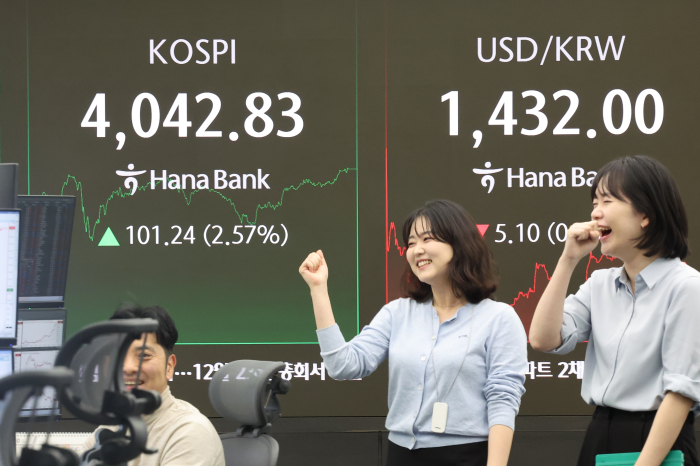
The Kospi ended 2.57% higher at 4,042.83, extending its October rally to more than 18%.
It has surged 68.5% so far this year, outperforming the S&P 500 nearly fourfold and ranking first among 42 major global equity benchmarks.
The rally has been powered by a perfect storm of global liquidity, a resurgent semiconductor cycle and market reforms championed by President Lee Jae Myung’s administration.

Since the US Federal Reserve began cutting rates in September, global investors have poured capital back into risk assets, fueling what traders are calling a liquidity-driven rally.
Analysts said the Kospi’s break above 4,000, once seen as a distant dream, has come to symbolize Korea’s new confidence, and perhaps the dawn of what local investors are calling the “K-premium” era.
AI, CHIPS AT THE HEART OF UPSWING
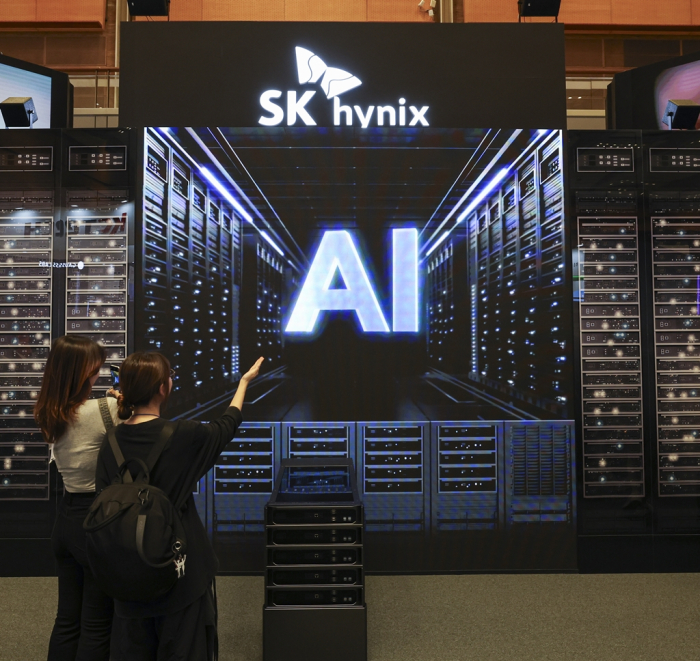
Chipmakers, driven by artificial intelligence demand, remain at the heart of the upswing.
Shares of Samsung Electronics Co. – one of Korea’s twin semiconductor giants – rose 3.24% to close at 102,000 won, cementing the long-awaited “shipman Samsung,” or the 100,000 won Samsung milestone.
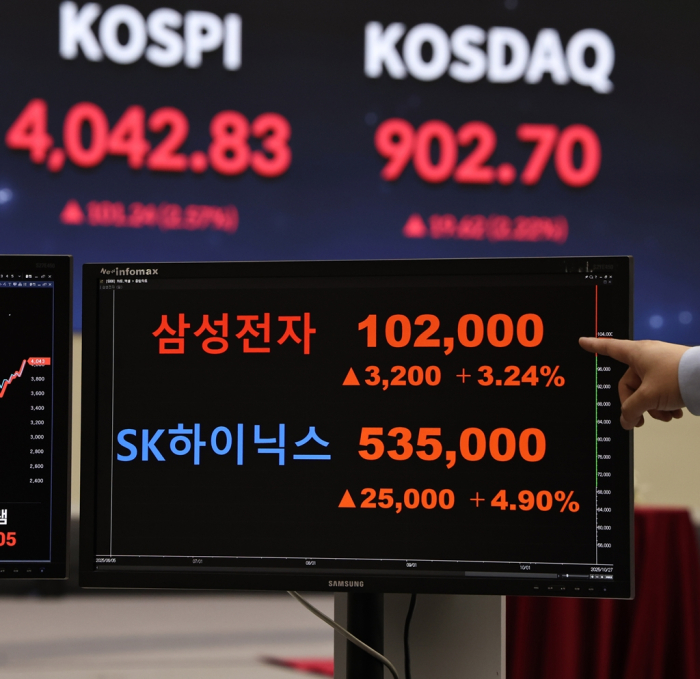
SK Hynix Inc., the leading supplier of AI chips, known as high-bandwidth memory (HBM), saw its shares jump 4.9% to 535,000 won on Monday.
‘END OF KOREA DISCOUNT’
The Kospi index climbed above 3,500 on Oct. 2, and then continued its relentless rise, reaching 3,600 on Oct. 10, 3,700 on Oct. 16, 3,800 on Oct. 20, and 3,900 on Oct. 24 shortly after the Chuseok holiday.
“The crossing of 4,000 points marks the end of the Korea discount,” said Kang Dae-kwon, chief executive of Life Asset Management. “It’s a symbolic event showing that the domestic market is finally being re-rated, and could mark the start of a money move from property to equities.”
Foreign investors have purchased nearly 12 trillion won ($8.4 billion) of Korean shares on the Korea Exchange since April, drawn by the country’s growing role in global supply chains, spanning shipbuilding, defense and nuclear power, and by a raft of policies designed to strengthen shareholder rights and improve market governance.
FURTHER UPSIDE: KOSPI 5,000 WITHIN REACH
With the benchmark surging past 4,000, market strategists are debating how far the rally can go.
Most market analysts forecast that if corporate earnings momentum continues and shareholder-friendly reforms intensify, the index could climb toward 5,000 by the first half of next year.
“This is just the beginning of a major bull market,” said Kang of Life Asset Management.
He expects Korea’s AI-led growth cycle to persist into next year, supported by reforms, including separate taxation of dividend income and governance restructuring.
CAUTION
Ahn Jung-hwan, CEO of Interlace Asset Management, pointed to a stronger position for minority shareholders following recent amendments to the commercial code.
“The value of individual investors’ holdings has risen significantly,” he said. “With inflation now tolerated globally, asset prices are trending higher across the board. Kospi 4,500 is well within reach.”

Jo Soo-hong, head of research at NH Investment & Securities Co., echoed the optimism.
“Export forecasts are being revised upward and shareholder-friendly policies are multiplying,” he said. “A (Kospi) move to 5,000 by mid-2026 looks achievable.”
Kim Tae-hong, CEO of Growth Hill Asset Management, noted that “when JPMorgan forecast 5,000 a few months ago, many thought it was excessive. But now it doesn’t look unrealistic. If the total shareholder return (TSR) ratios rise to global standards, 5,000 is possible.”
Others remain cautious, stressing that earnings growth must follow.
“To justify a 5,000 level, companies’ aggregate operating profit needs to rise from 200 trillion won to 300 trillion won,” said Lee Jin-woo, head of research at Meritz Securities. “That’s something we’ll only be able to confirm in the first half of next year.”
NEXT DRIVERS: FINANCE, DEFENSE, ENERGY
While semiconductors are expected to remain the dominant growth engine, with AI-driven demand keeping supply tight, analysts are highlighting new leaders across finance, defense and nuclear energy.
“If the dividend tax rate is eased to 25%, financial stocks could see another leg up,” said Kang of Life Asset Management.
Lee of Meritz described shipbuilding, defense and nuclear energy as “mega-trend industries promoted by the state.” He said the upward trajectory of those sectors “is not in doubt.”
Strategists recommend investors maintain equity exposure through the end of the year.
“There’s no need to wait for a correction,” said Baek Young-jin, head of research at Sangsangin Investment & Securities Co. “Investors should start thinking about taking profits only after the first half of next year.”
Ahn of Interlace said: “Even if we see short-term pullbacks, the downside is limited. With the value of cash eroding, allocating a portion of assets to equities remains a sound strategy.”
By Sung-Mi Shim, Han-Shin Park and Han-Gyeol Seon
smshim@hankyung.com
In-Soo Nam edited this article.