South Korea has proposed an unlimited currency swap with the US to fulfill its pledge to form a $350 billion US investment fund, but the offer failed to narrow their differences over the fund launch, according to Korean government sources on Sunday.
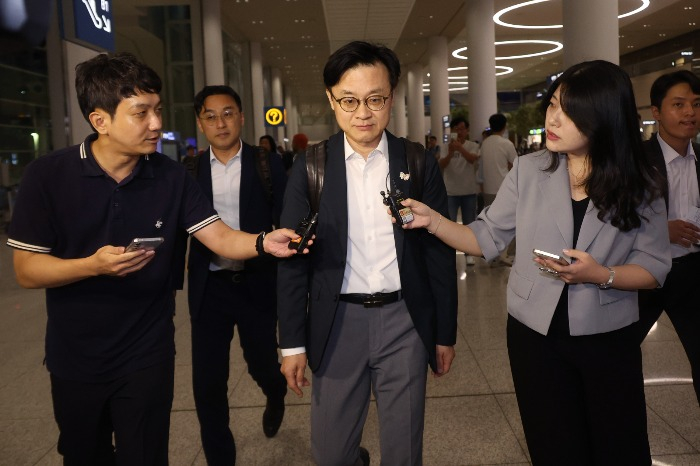
Seoul floated the currency deal in a meeting between Soth Korean Minister of Trade, Industry and Energy Kim Jung-kwan and US Commerce Secretary Howard Lutnick in New York last week.
However, Washington has has rejected the proposal, signaling their follow-up negotiations on the trade agreement, signed in July, will be likely to drag on further.
“As far as I know, the US Fed is fundamentally reluctant to enter into a currency swap agreement with a single country,” a senior Korean government official told The Korea Economic Daily.
A $350 billion fund was a central part of their broader tariff agreement to cut reciprocal tariffs to 15% on Korea-made products, including automobiles and auto parts.
On Sept. 10, the trade minister flew to New York to continue negotiations with Lutnick about the structure and funding of the inveatment commitment, as well as on how to share returns from investments.
He returned to Seoul empty-handed on Sept. 14. When asked about the status of the talks, the minister said that negotiations were ongoing and declined to provide further details.
DEMAND FOR DIRECT CASH INJECTION
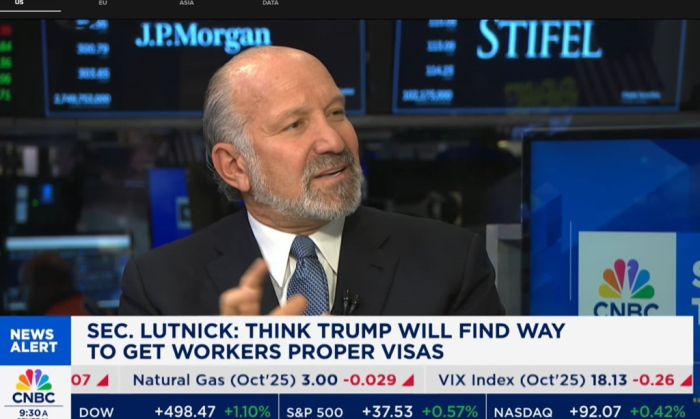
On Sept. 12, Lutnick said in an interview with CNBC that South Korea either accept that deal or pay the tariffs of 25% on exports to the US.
He is pushing South Korea to establish a special purpose company in the US and injected $350 billion into the vechile in cash.
But South Korea prefers the fund to be structured in the form of payment guarantee and loans, similar to the agreement the European Union reached with the US in July.
Seoul said that $350 billion is equivalent to 84% of South Korea’s foreign exchange reserves as of the end of August, thus raising the fund will destabilize domestic foreign exchange market.
Last week, Kim Yong-beom, presidential chief of staff for policy, said at a forum hosted by the Korea Broadcasting Journalists Club that the question of how to raise $350 billion in the foreign exchange market and operate it must be addressed as a priority between trade talks with Washington.
In 2028 and 2020, South Korea entered into a currency exchange deal with the US for $30 billion and $60 billion, respectively, as part of efforts to stabilize the domestic financial market hit hard by the global financial crisis and the COVID-19 outbreak.
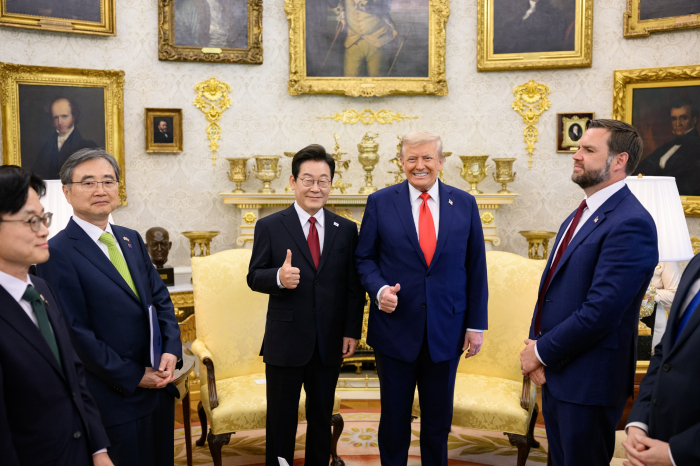
Regarding the final signing of the US-Korea trade deals, South Korean President Lee Jae Myung said during a press conference marking his first 100 days in office on Thursday that Korea “will sign if it is good, but why sign if it is not in our interest?”
Washington has ratcheted up pressure on Seoul to deliver on its $350 billion investment pledge after Tokyo finalized its $550 billion commitment to the US early this month.
In response, the US will cut tariffs on Japanese cars to 15% from 25%, starting Sept. 16.
By Jeong-Min Nam, Dae-Hun Kim and Hyung-Kyu Kim
peux@hankyung.com
Yeonhee Kim edited this article.