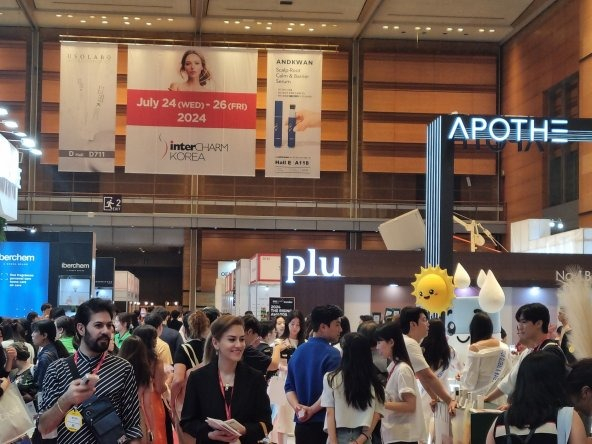
South Korean brands are diversifying overseas markets to accelerate global expansion as the 15% US tariff and intensifying competition may hinder growth in the world’s top cosmetics market.
South Korea’s cosmetic exports rose 17.1% to $935.2 million in July from a year earlier, led by strong sales to Europe and the Middle East, according to customs data provided by Hankyung Aicel, the alternative data platform of The Korea Economic Daily, on Sunday.
Cosmetics shipments to Belgium and Spain surged 100% and 97.6%, respectively, while sales of beauty products to Greece and France jumped 71.7% and 70.4%, respectively. Exports to the UK, one of South Korea’s ten largest beauty markets, rose 22.8%.
In the Middle East, cosmetics shipments to Saudi Arabia grew 48% and sales to the United Arab Emirates advanced 38.8%. Exports to Iran and Iraq also rose 15.8% and 5.1%, respectively.
Beauty product exports to the United States, the world’s largest cosmetics market, increased 17.8% to $198.6 million in July. Seoul and Washington have reached a trade agreement setting the new tariff rate at 15$ a day before the US-imposed Aug. 1 deadline.
“As competition has intensified in the US this year, K-beauty brands are strategically turning to Europe and the Middle East,” said a South Korean beauty industry source. “The K-beauty craze is spreading in Europe, especially in the UK.”
DIVERSIFY SELLING CHANNELS
The South Korean beauty industry is also diversifying its selling channels to reduce the dependence on major e-commerce platforms such as Amazon.com.
Major platforms, which usually help cosmetics brands to boost sales, pressure sellers to lower prices, squeezing their profit margins. Some global e-commerce players such as Amazon.com, known for their lowest-price policy, often block product listings that are not offered cheaper than on other platforms.
The UK is one of the key markets where K-beauty brands are investing in diversifying their sales channels. Boots, a drugstore chain with over 2,000 shops in the UK, increased the number of K-beauty brands it carries to 21 this year from 10 last year.
South Korean beauty brands are also actively expanding their presence in France’s Sephora, Germany’s Douglas, Poland’s Notino, and Russia’s Gold Apple.
Among 25 platforms in seven countries, including the US, the UK, France, Germany, Poland, the Czech Republic, and Russia, which sell South Korean beauty products, 19 operate web pages dedicated to K-beauty, according to Daol Investment & Securities Co. in Seoul.

NOT ONLY AMAZON BUT ALSO TIKTOK SHOP
The South Korean beauty industry recently focused more on digital platform diversification. In the US, 2.6% of beauty product purchases were made last year on TikTok Shop, an e-commerce feature of the world’s most popular video hosting service. More customers are buying cosmetics on the platform.
“With the added burden of the 15% US tariff, it’s extremely difficult for smaller brands to compete with major players on global platforms like Amazon,” said a beauty brand chief executive. “We have to either push into Europe more aggressively or find success on new platforms such as TikTok Shop.”
South Korean beauty product brands are attempting to offer different product bundles to stay competitive on Amazon.com, but it is not a fundamental strategy, industry sources in Seoul said.
“Beyond simply changing product bundles, this is a critical time to invest in securing multiple sales channels in various countries, even if it takes more effort,” another industry source said.
“While the US remains the largest market with platforms like Amazon and iHerb, we are making efforts not to become overly dependent on it.”
By Yun-Sang Ko
kys@hankyung.com
Jongwoo Cheon edited this article.